Planning a trip around architecture and want bamboo buildings to visit? Start with Bali’s Green School, then add Thailand’s Panyaden sports hall and Tulum’s Luum Temple. Each shows what treated bamboo can do.
This guide is one part of the wider topic of sustainable travel, so it keeps the focus on buildings you can plan a trip around.
| Building or site | Key fact |
|---|---|
| The Arc, Green School, Bali | 14-metre-high cane arches |
| Panyaden sports hall, Chiang Mai: trusses | 17 metres |
| Panyaden sports hall, Chiang Mai: size | 782 square metres |
| Impression Sanjie Liu canopy, Yangshuo | 140 metres long |
| Bamboo Pavilion, Taichung | Structure sourced from 320 plants |
| Vedana Restaurant roof | 36 bamboo modules |
Figures come from Dezeen’s 4 August 2021 bamboo roundup and, for the sports hall area, CNN Style’s November 2021 report. Details can change, so check the source before you rely on them.
Bamboo buildings to visit in Asia
Several of the best-known projects in the two sources above sit in Asia. These are the ones with a clear location.
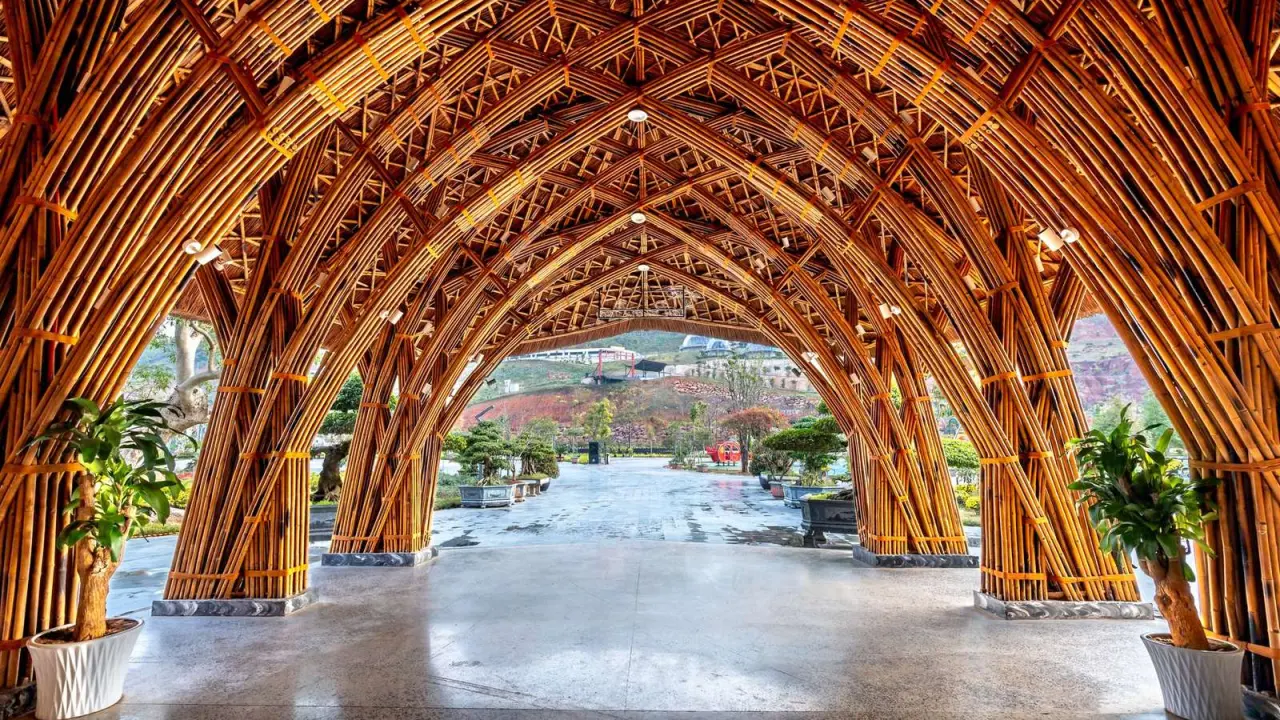
- The Arc, Green School, Bali. Studio Ibuku built a self-supporting bamboo roof for the school gymnasium from 14-metre-high cane arches. The campus is set in a village near Ubud.
- Panyaden International School sports hall, Chiang Mai. Its 17-metre trusses were prefabricated on site and lifted into place by crane. The open lattice cuts out the need for air conditioning.
- Casamia Community House, near Hoi An. VTN Architects built this entrance hall to the Casamia Resort on the outskirts of the UNESCO World Heritage site of Hoi An town.
- Impression Sanjie Liu canopy, Yangshuo. A hand-woven bamboo canopy, 140 metres long, shelters visitors to a light show on an island in the Li River.
Panyaden’s architects claim the sports hall absorbed more carbon in its materials than its construction emitted. That is the firm’s own claim, so treat it as a design goal rather than an audited result.
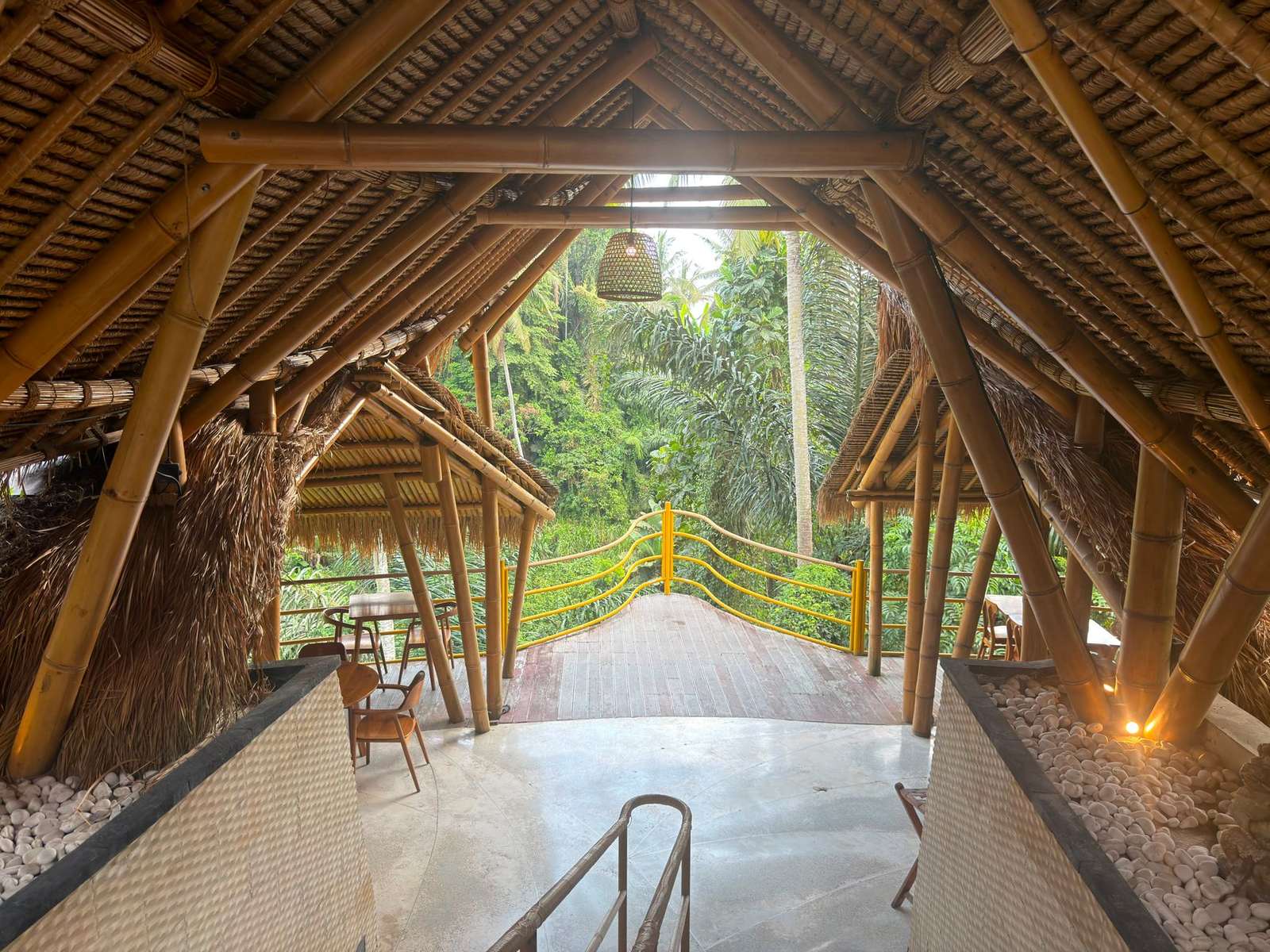
Vo Trong Nghia’s Vedana Restaurant is worth knowing too. Its roof looks like three thatched gables but is a single structure of 36 bamboo modules, and the Dezeen roundup does not give a location, so confirm where it stands before you plan around it.
Bamboo buildings beyond Asia
You do not need a long-haul flight to see every example. The same roundup includes projects in Mexico, Senegal and France.
- Luum Temple, Tulum. This jungle yoga studio is formed from five parametrically designed arches bound by two layers of lattice, built to resist hurricane forces.
- Thread, Senegal. Toshiko Mori’s undulating bamboo canopy drapes over the whitewashed buildings of a cultural hub, reinterpreting a traditional thatched roof around open-air courtyards.
- Hardelot Theatre, near Calais. Twelve-metre-high bamboo poles encircle a cylindrical playhouse designed as a homage to Shakespeare’s Globe Theatre.
Each one shows a different climate response. Tulum’s design addresses storms, Senegal’s reworks a thatched roof, and Hardelot’s gridded cage sits on the French coast.
Which of these can you actually visit?
Not every project in a design roundup is a permanent, open building. Kengo Kuma’s Bamboo Ring was installed at the V&A for London Design Festival 2019, and Penda’s Rising Canes was a prototype exhibited at Beijing Design Week.
Others sit inside a school campus, a resort, a restaurant or a yoga studio, so public access varies. The Dezeen roundup is an archive and does not report opening status, so use this routine before you book anything.
- Search for the venue’s own page and confirm the building still stands.
- Check whether it is open to the public or only to students, guests or customers.
- Ask about visiting hours, since a light show or school day may set them.
Why bamboo suits low-carbon building
After being abandoned in favour of concrete and steel in the 20th century, bamboo is returning to modern buildings. Dezeen says its rapid growth makes it affordable and rapidly renewable, and able to sequester large amounts of carbon from the atmosphere.
It needs care, though. The Conversation notes that untreated bamboo is highly susceptible to fire and degrades within two or three years, while treatment often involves a soaking solution that includes borax salt powder. Ibuku says it uses a natural, non-toxic boron solution that makes the bamboo biodegrade slower and keeps insects away.
The material is also old. Some Chinese bridges date back as far as the 10th century AD, and archaeologists in Ecuador found a bamboo funeral chamber carbon-dated to 7500 BC.
Even skilled designers find it demanding. Nghia said it is not easy to create beautiful spaces with bamboo because it is an uneven material, which is why his studio uses unit-frame prefabrication.
Planning a lower-impact bamboo trip
Bali, Chiang Mai and Hoi An all lie in Southeast Asia, so you can group several sites into one region. The guide to sustainable travel in southeast asia is a useful next read for that kind of route.
If you fly, read about carbon offsets for travel before you buy any. Whatever you decide, treat slow travel as a way to see more buildings per journey rather than fewer.
Frequently asked questions
Which bamboo building should I see first?
Show answer
Bali’s Green School is a strong first choice. Its Arc gymnasium roof is made entirely from bamboo, and the campus sits in a village near Ubud.
Is bamboo a sustainable building material?
Show answer
Dezeen describes it as rapidly renewable and able to sequester large amounts of carbon. It still needs treatment against fire and pests, so durability depends on how it is prepared.
How long does untreated bamboo last?
Show answer
The Conversation says untreated bamboo naturally degrades within two or three years. Treatment and drying are what make it suitable for lasting buildings.
Are all these bamboo buildings open to the public?
Show answer
No. Some were exhibition installations or prototypes, and others are inside schools, resorts or studios. Check each venue’s own information before you travel.